· Prices checked · 6 min · Hiring developers · Humza Sheikh
Dedicated Developers vs In-House Hiring: Cost and Fit
What a senior developer costs in-house versus embedded in your team, by country, with employer taxes sourced, and when an in-house hire is the better call.
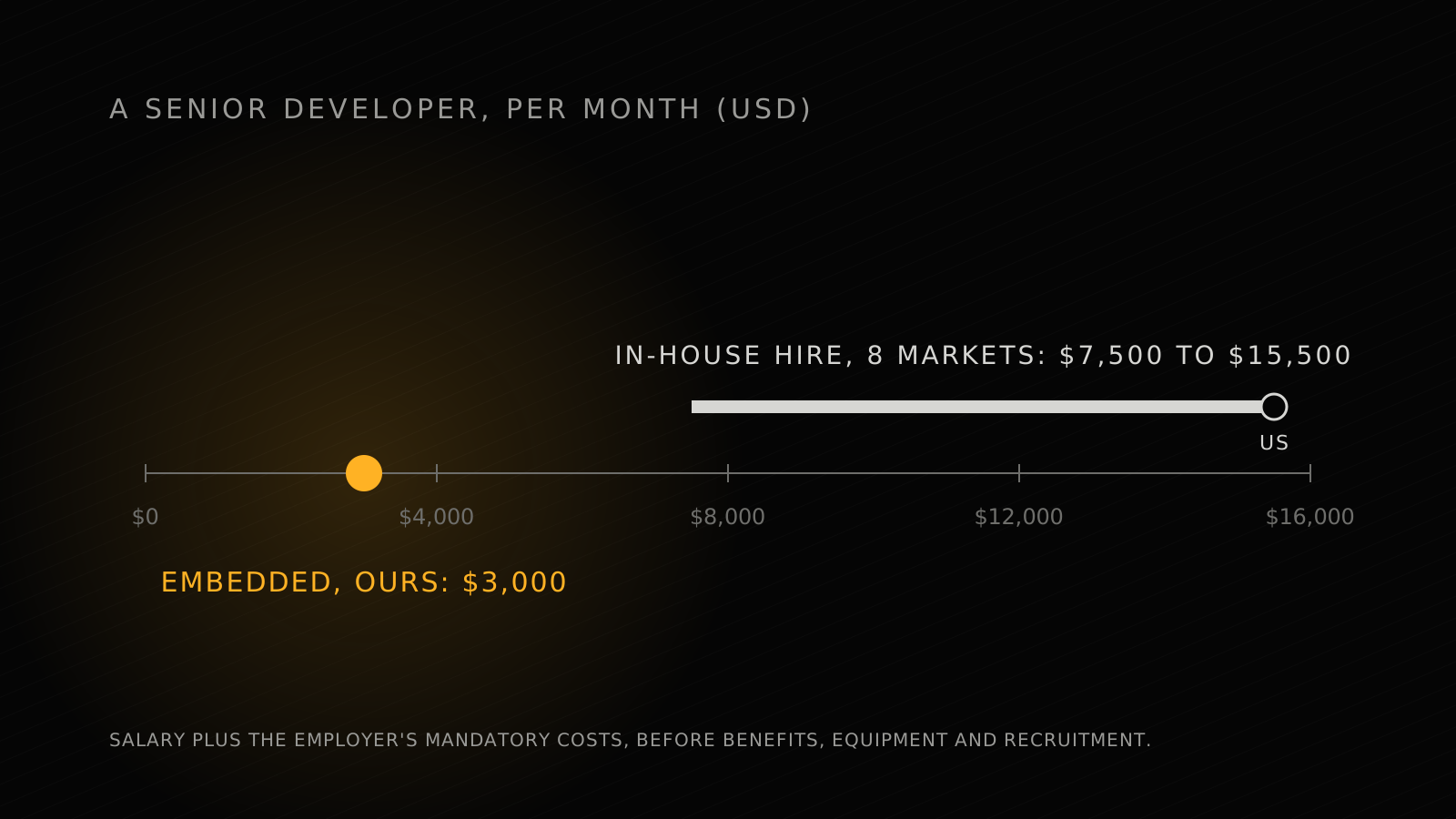
The short answer: an in-house developer is your own employee. A dedicated developer (also called an embedded developer, or staff augmentation) works only on your product, in your repo and your standups, but is paid and managed through a partner. A senior in-house developer costs an employer about $15,500 a month in the US and $10,500 in the UK, salary plus mandatory employer taxes, before benefits and recruitment. Our dedicated developers are $3,000 a month, start within 7 days and need no notice to stop.
Choose in-house when the role is core to your company for years and you can recruit and manage developers well. Choose a dedicated developer when you need senior output now, without a hiring round or a fixed salary. The rest of this guide shows the working, from official pay and tax sources.
What's the difference between a dedicated and an in-house developer?
| In-house developer | Dedicated (embedded) developer | |
|---|---|---|
| Who you pay | The developer: salary, employer taxes, benefits | One monthly fee to a partner, such as us |
| Who sets the work | You | You |
| Who manages performance and cover | You | The partner |
| Works in | Your repo, tools and standups | Your repo, tools and standups |
| Time to start | A hiring round, then the candidate's notice period | Ours: within 7 days of a call |
| To stop | Notice period and employment law | Ours: no notice period, month to month |
The day-to-day work looks the same. The difference is who carries everything around the work: the hiring, the pay, the management and the risk of a wrong fit.
What does an in-house developer really cost?
Start with the salary. The median US software developer earned $135,980 a year in May 2025, and the highest 10 percent earned more than $214,670 (US Bureau of Labor Statistics). That median is about $11,330 a month.
Then the employer's taxes. In the US, the employer pays 6.2% Social Security and 1.45% Medicare on top of the salary, with Social Security on earnings up to $184,500 in 2026 (IRS). That takes the median developer to about $12,200 a month, before health insurance, equipment or a recruiter's fee.
In the UK, the employer pays 15% National Insurance on earnings above £5,000 a year in 2026 to 2027 (GOV.UK), and at least 3% of qualifying earnings into a workplace pension (GOV.UK).
A senior developer, the kind you'd trust to own a feature, costs more than the median. Our estimates for a senior developer, salary plus the employer's mandatory costs, by market:
| Market | Senior hire, per month (USD) | Source behind it | Ours, per month |
|---|---|---|---|
| US | $15,500 | BLS, 75th percentile, plus payroll taxes | $3,000 |
| Australia | $11,000 | Robert Walters Salary Guide 2026, plus 12% super | $3,000 |
| UK | $10,500 | ONS ASHE, 75th percentile, plus employer NICs and pension | $3,000 |
| Singapore | $9,500 | MOM Occupational Wages 2025, plus employer CPF | $3,000 |
| UAE | $9,500 | Robert Walters Middle East Salary Survey 2026, plus end-of-service gratuity | $3,000 |
| Canada | $8,500 | Robert Half 2027 Salary Guide, plus CPP and EI | $3,000 |
| Ireland | $8,500 | Morgan McKinley 2026 Salary Guide, plus employer PRSI | $3,000 |
| New Zealand | $7,500 | Robert Walters Salary Guide 2026, plus KiwiSaver | $3,000 |
Converted to US dollars at 26 October 2026 rates and rounded to $500. These are the same figures our hire AI developers page shows visitors from each country.
Our monthly estimates above × 12, salary plus the employer's mandatory costs only. Ours is $3,000 a month × 12.
Over a year, that's $150,000 less than a senior US hire and $90,000 less than a senior UK hire, before counting benefits, equipment or recruitment on the in-house side.
How fast can each one start?
An in-house hire needs a job advert, interviews, an offer and then the candidate's notice period at their current job before day one.
A dedicated developer skips all of that. Ours works like this:
- A 15-minute call about your stack, your roadmap and the seniority you need.
- We match a senior developer to your stack. 96% of our matches stick.
- A 7-day trial. They join your standups and ship in your repo. Pay nothing if it isn't right.
- Every week after that, a video report on what shipped, what's next and what's blocked. No contract and no notice period.
If a developer stops being the right fit later, we replace them within 7 days.
Who manages the developer?
With an in-house hire, you do: one-to-ones, performance, holiday cover and, if it goes wrong, the exit.
With a dedicated developer, you set the priorities and the partner handles the rest. Ours join your daily standups in Slack, Teams or your own tool, work in your repo and your project board, and ship with Claude Code from day one. A manager on our side handles performance and cover, so you don't chase progress.
That was the point for Rize Digital, an agency. We took over all of its development work and planning, so the founder could focus on growth, and delivery got 300% faster (our work).
When is an in-house developer the better choice?
| Choose | If |
|---|---|
| An in-house hire | The role is core to your company for years, you want the knowledge to stay inside, and you can recruit, manage and keep developers. |
| A dedicated developer | You need senior output now, your roadmap is slipping, you don't want a recruitment fee or a notice period, or you're not sure the role will exist in a year. |
| A project team | You need a whole product built, not a person in your team. See our MVP development service. |
| Neither yet | You don't have enough work to fill a developer's week. |
When we're the wrong choice: if you want someone on your payroll who builds a team around them over years, hire in-house. A dedicated developer is the faster, cheaper way to add senior capacity, not a replacement for every permanent role.
Can you combine in-house and dedicated developers?
Yes. You can keep a small in-house core that owns the architecture and product decisions, and add dedicated developers for capacity when the roadmap grows. Because ours run month to month, you can add one for a launch and stop when it ships, with no notice period.
Common questions
Is a dedicated developer the same as staff augmentation?
Yes, mostly. Staff augmentation, embedded developers and a dedicated development team all mean developers who work inside your team while you pay and manage them through a partner. Outsourcing usually means handing a whole project to an agency instead.
How much does it cost to hire a software developer in-house?
The median US software developer earned $135,980 a year in May 2025 (BLS). With the employer's Social Security and Medicare, that's about $12,200 a month. A senior hire costs about $15,500 a month in the US and $10,500 in the UK on our estimates, before benefits, equipment and recruitment.
Will a dedicated developer work our hours and use our tools?
Ours do. They join your daily standups and work in your repo, your project board and your chat.
What if the developer isn't the right fit?
With us, pay nothing in the first 7 days. After that, we replace the developer within 7 days.
Want a senior developer in your team next week?
Hire an AI-native developer for $3,000 a month, with no recruitment fee, a 7-day trial and no notice period. Book a 15-minute call and we'll tell you honestly whether embedding or hiring fits your roadmap better.
Sources
Checked 31 October 2026.
- US pay: BLS, software developers
- US employer taxes: IRS Topic 751, Social Security and Medicare withholding rates
- UK employer taxes: GOV.UK, rates and thresholds for employers 2026 to 2027
- UK pensions: GOV.UK, workplace pension contributions
- Senior-hire estimates by market: the sources in the table above, researched 26 October 2026
- Our price, terms and results: hire AI developers and our work