· Prices checked · 6 min · Android app modernization · Humza Sheikh
Google Play 16 KB Page Size: What App Owners Must Do
Google Play's 16 KB page size rule in plain words: which apps it affects, the 1 February 2027 date for updates, how to check yours and what the fix costs.
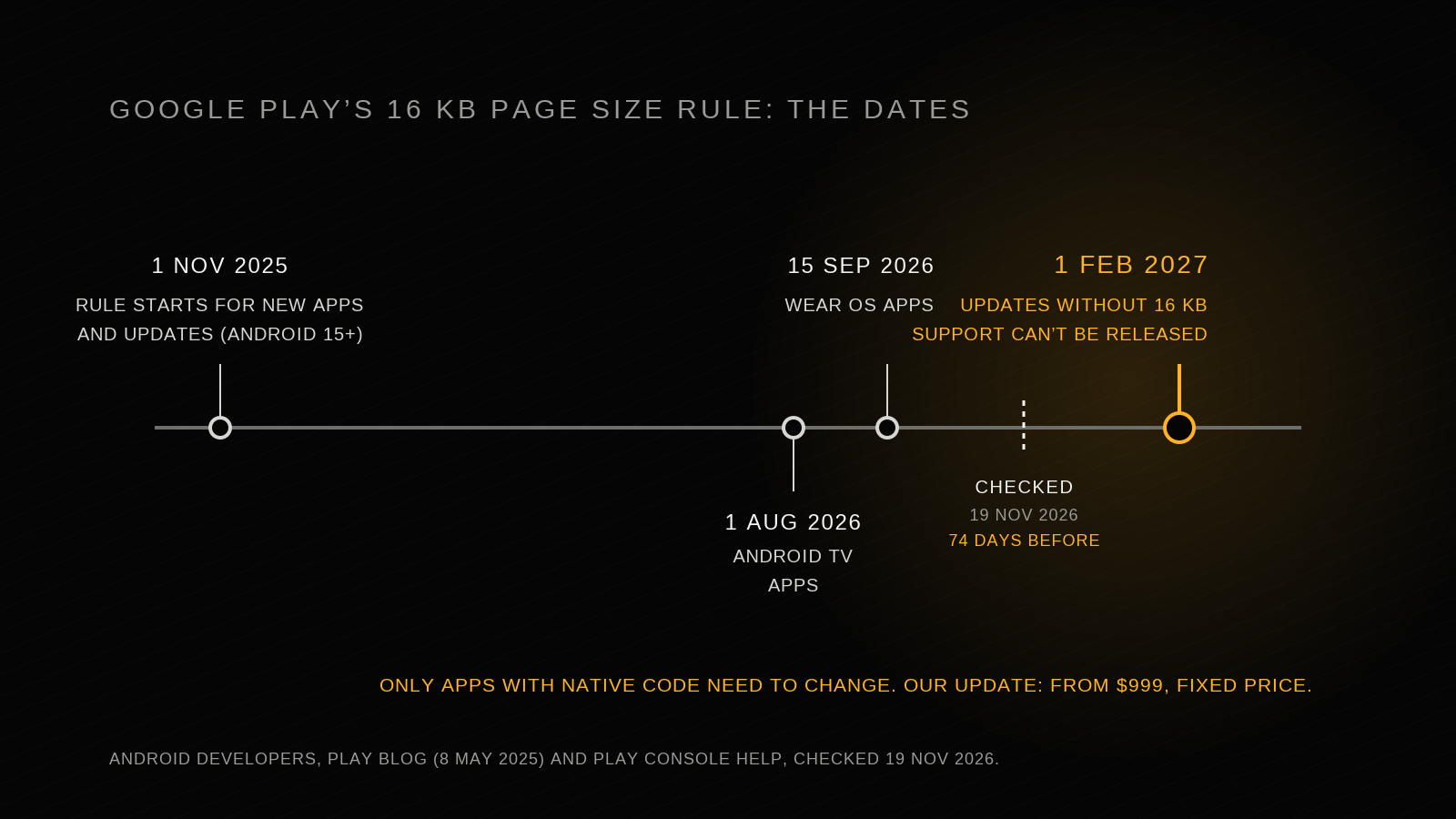
The short answer: Android phones are moving from 4 KB to 16 KB memory pages, and Google Play now requires every app that targets Android 15 (API level 35) or higher to support them on 64-bit devices. The date that matters is 1 February 2027: from then, Android Developers says an app update that doesn't support 16 KB page sizes can't be released. That's 74 days from when we checked, on 19 November 2026.
Most apps are fine already. If your app is written only in Java or Kotlin, and none of its SDKs ship native code, there's nothing to change. If it has native code, it needs rebuilding with current tools and testing on a 16 KB device. We do that from $999 at a fixed price, on a date agreed with the quote, or we keep working free until it's live.
What is Google Play's 16 KB page size requirement?
A memory page is the block of memory the operating system hands out at a time. Android has always used 4 KB pages. From Android 15, Android supports devices built with 16 KB pages, and Google expects more of them as phones get more memory. An app with native code that was built for 4 KB pages has to be rebuilt to work properly on those devices.
Google Play turned that into a rule. These are the dates, from Google's own pages, checked 19 November 2026:
| Date | What applies | Source |
|---|---|---|
| 1 November 2025 | New apps and updates targeting Android 15 and higher must support 16 KB page sizes | Android Developers Blog, 8 May 2025 |
| 1 August 2026 | Android TV apps: 64-bit and 16 KB support required | Play Console Help |
| 15 September 2026 | Wear OS apps: 64-bit and 16 KB support required | Play Console Help |
| 1 February 2027 | App updates that don't support 16 KB page sizes can't be released | Android Developers |
The 1 February 2027 date is the one Google shows in the Play Console warning on its Android Developers page. If you've seen a message in Play Console about 16 KB memory page sizes, this is what it means.
Why does it affect every app that still gets updates?
Because of a second rule. Since 31 August 2026, Google Play only accepts new apps and updates that target Android 16 (API level 36), which we covered in Google Play's target API level rule. Any update you publish now targets API 36, so it targets "Android 15 and higher", so the 16 KB rule applies to it.
Put the two together and the position is simple. From 1 February 2027, an app with unaligned native code can't ship an update at all: not a new feature, not a price change, not a one-line bug fix. The app stays installed for the people who have it, but you can't change it until the native code is fixed.
Does your app need to change?
Only if it has native code. Android Developers says an app uses native code if any of these apply:
- it has its own C or C++ code, built with the Android NDK;
- it links a third-party library or SDK that ships native code;
- it was made with a third-party app builder that uses native libraries on the device.
If your app uses only Java or Kotlin, including every library and SDK, it already supports 16 KB devices. Google still recommends testing it once in a 16 KB environment.
How do you check your app?
Your developer can check in a few minutes, from a built copy of the app, without changing any code:
- Open the app in APK Analyzer. In Android Studio, Build, then Analyze APK.
- Look in the `lib` folder. If there's no `lib` folder, or no `.so` files in it, the app has no native code.
- Read the Alignment column. APK Analyzer shows a warning beside any `.so` file that isn't 16 KB aligned. Android Studio's lint also flags them.
If you don't have a developer, check Play Console first. Google shows the 16 KB warning there for affected apps, and that's where you'll see whether yours is one of them.
What does the fix involve?
For most apps it's a rebuild with current tools rather than new code. According to Android Developers:
| What | Why it matters |
|---|---|
| Android Gradle Plugin 8.5.1 or higher | Packages native libraries on 16 KB boundaries. Apps on AGP 8.3 to 8.5 can look fine in testing but fail to install when built from a bundle on Play |
| NDK r28 or higher | Compiles native code 16 KB-aligned by default. Older NDKs need two linker flags |
| 16 KB-ready SDKs | A third-party SDK's own native libraries have to be aligned too, so some SDKs need updating to a newer version |
| Code that assumes 4 KB | Code that hard-codes the page size as 4096 has to ask the device instead |
| Testing on a 16 KB device | A 16 KB emulator image, or a Pixel 8 or later booted with the 16 KB developer option. The test device answers 16384 when asked its page size |
The SDKs are usually where the time goes. If an SDK the app depends on has no 16 KB-ready version, it has to be replaced, and that's when an update turns into a bigger job. That's why the work starts with an audit.
What does it cost to fix?
With us, from $999 at a fixed price, the same as any update to meet Google Play's current rules. It covers what our Android app modernization service covers:
| Step | What happens |
|---|---|
| Audit | What blocks the update, and the fix, with a fixed price and a date we commit to |
| Update or rebuild | The app meets the current Android requirement, 16 KB support included; outdated libraries and SDKs are replaced |
| Testing | On current Android versions and devices |
| Release | Submitted and taken through Google Play review |
The guarantee: live on Google Play and meeting its current Android requirement by the agreed date, or we keep working free until it is. It's paid in milestones, and if the code can't be updated we quote a rebuild, still at a fixed price before any work starts.
If your app is also behind on its target API level, it's one job, not two: the update that moves it to API 36 is the same one that has to support 16 KB.
What happens if you do nothing?
Until 1 February 2027, nothing visible. After it, an app with unaligned native code can't take an update, so the next bug, payment SDK change or Android change you need to ship is blocked until the native code is fixed. That's a bad time to find out, with a broken release waiting.
Google also says that without recompiling, apps with native code won't work on 16 KB devices in future Android releases. A 16 KB device can run some unaligned apps in a compatibility mode, with a warning on first launch, but Google says that only lets some apps work, and that apps should still be 16 KB aligned.
For apps that change often, a developer who joins your team from $3,000 a month keeps them current with each year's rule alongside everything else.
Common questions
What is the 16 KB page size requirement on Google Play?
Apps that target Android 15 (API level 35) or higher must support devices with 16 KB memory pages on 64-bit devices. From 1 February 2027, Google Play won't let you release an update that doesn't.
Does the 16 KB rule affect apps written in Kotlin or Java?
Not if the whole app, including every library and SDK, is Java or Kotlin. Those apps support 16 KB already. It affects apps with native code, which many apps get through a third-party SDK without anyone on the team writing C or C++.
What happens to my app on 1 February 2027?
It stays on Google Play for the people who have it. What stops is your ability to publish updates, until the app supports 16 KB page sizes.
Is this the same as the target API level rule?
No, but they meet. The target API rule says updates must target API 36. The 16 KB rule applies to apps targeting API 35 and higher. So every update now has to meet both, and we fix both in one update.
How long does the fix take?
It depends on how much native code the app has and whether its SDKs have 16 KB-ready versions. We audit first, then give you a fixed price and a date we commit to.
Does this affect my iPhone app?
No. This is a Google Play rule for Android apps. Our service covers Android and Google Play; ask on the call about iOS.
Not sure if your app is affected?
Send us the Play Store link. Our Android app modernization service checks it for native code and 16 KB alignment, quotes a fixed price and a date, and takes the update through Play review, or we keep working free. Book a 15-minute call.
Sources
The requirement, the 1 February 2027 date, what counts as native code, the checks, the tools and the tests are from Android Developers, Support 16 KB page sizes. The 1 November 2025 start is from the Android Developers Blog, Prepare your apps for Google Play's 16 KB page size compatibility requirement (8 May 2025). The TV and Wear OS dates are from Play Console Help, Play Console technical quality requirements. The target API level rule is from Play Console Help, Target API level requirements for Google Play apps. All checked 19 November 2026. Our price, steps and guarantee are from our Android app modernization page.