· Prices checked · 6 min · MVP development · Humza Sheikh
MVP Development Cost: The Price and What's Left Out
What MVP development costs at a fixed price, what a quote should include (sign-in, billing, hosting), and the running costs that start the day you launch.
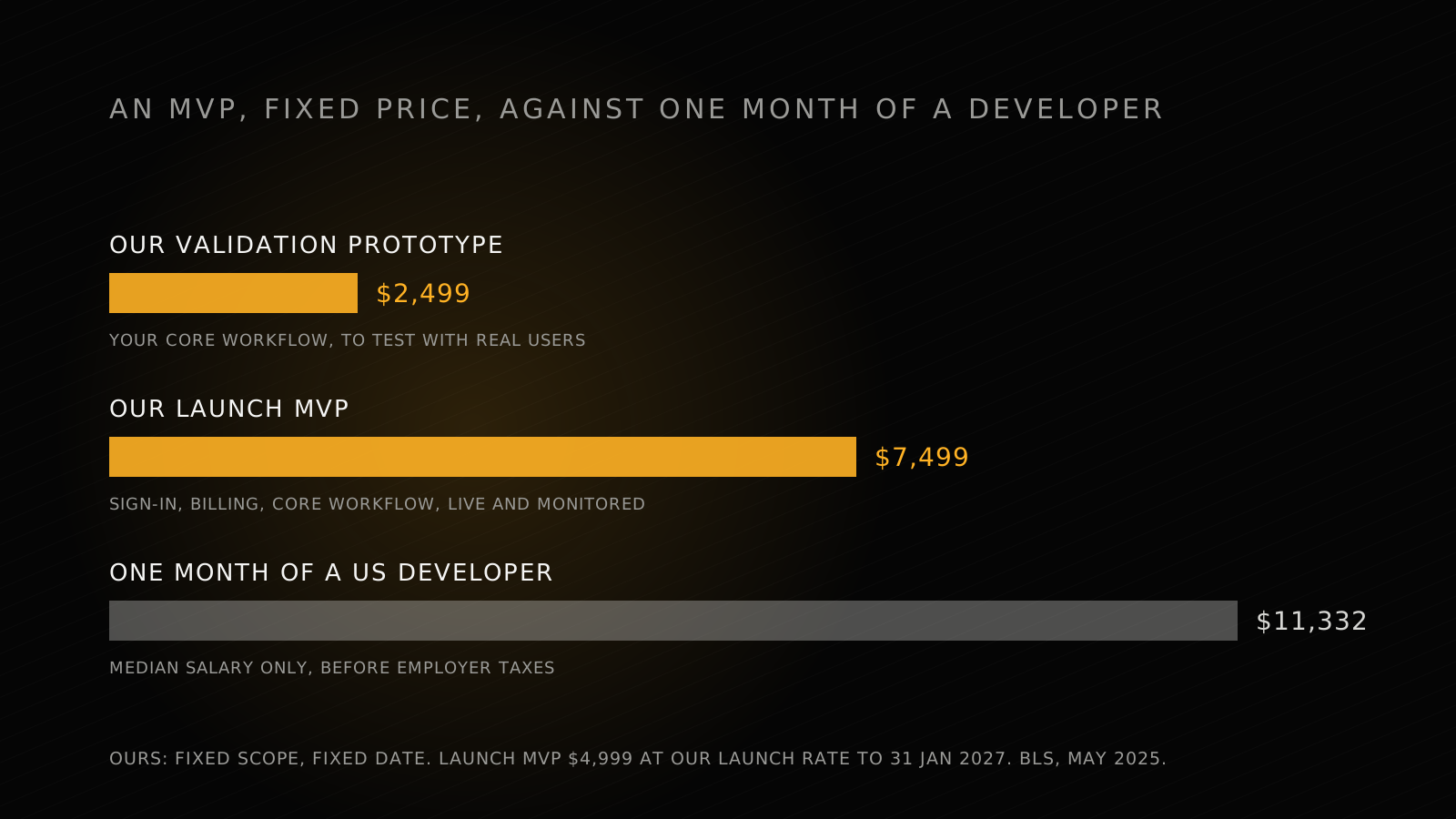
The short answer: an MVP (minimum viable product) costs $2,499 with us for a validation prototype of your core workflow, and $7,499 for a launch MVP that customers can sign in to and pay for, live, hosted and monitored ($4,999 at our launch rate until 31 January 2027). Both are fixed-price, fixed-scope and fixed-date. If we miss the date, we keep building free until it's live.
For scale: the median US software developer earned $135,980 in May 2025, which is $11,332 a month in salary alone, before employer taxes. Our launch MVP costs less than one month of that salary.
The price of an MVP isn't the only number that matters, though. The cost that catches founders out is the one a quote doesn't mention: the parts that turn a demo into something people can pay for, and the bills that start the day it goes live.
How much does MVP development cost?
These are our prices, from our MVP development page:
| What you get | Price | At our launch rate (until 31 January 2027) | Includes |
|---|---|---|---|
| Validation prototype | $2,499 | $2,499 | A working version of your core workflow, to test with real users before you build the rest |
| Launch MVP | $7,499 | $4,999 | Sign-in, billing and your core workflow, live, hosted and monitored |
| Larger builds | Quoted per project | Quoted per project | Scoped and priced after a 15-minute call |
Every option is a fixed project, paid in milestones. You get a fixed price before we start and a date we commit to, and the guarantee covers it: delivered to the agreed scope by the agreed date, or we keep building free until it's live.
What should an MVP quote include?
An MVP is the smallest version of your product that does its one job well enough for people to pay for it. That last part is where quotes differ most. A quote can describe "the app" and still leave out everything a paying customer touches first.
Before you compare two prices, check each quote for these five things:
- The core workflow: the one thing the product must do well.
- Sign-in: accounts and roles, so each customer sees their own data.
- Billing: subscriptions or one-off payments, working on day one.
- Hosting: the product live on a real address, not a demo link.
- Monitoring and analytics: so you know when it breaks and what people use.
Our validation prototype covers the first one on purpose: it exists to test whether the core workflow is worth building out before you pay for the rest. Our launch MVP covers all five.
A low price with sign-in, billing or hosting missing isn't a cheaper MVP. It's a smaller piece of one, and the missing parts get quoted later, once you're already committed to that team and that code.
What does an MVP cost to run after launch?
The build is a one-off. Two bills start the day the product goes live, and neither is in a build quote:
- Taking payments. Stripe's UK pay-as-you-go rates are 1.5% + 20p for standard UK cards, plus 0.7% of billing volume for Stripe Billing, which runs subscriptions.
- Hosting. On Railway, which hosts this site, plans start at $5 a month on Hobby and $20 a month per workspace on Pro, each including that much usage, with usage above it charged on top.
Here's what collecting payments costs at a modest size, worked through on those Stripe rates:
| Line | Rate | On £10,000 a month (200 × £50) |
|---|---|---|
| Card fees | 1.5% | £150 |
| Per-payment fee | 20p × 200 | £40 |
| Stripe Billing | 0.7% | £70 |
| Total | £260 a month (2.6% of sales) |
That cost grows with your sales, which is the right way round: you pay it because people are paying you. The launch MVP includes setting up hosting, monitoring and analytics, so these bills are known and visible from the first day.
Is it cheaper to hire a developer to build it in-house?
Usually not for a first version. An employee is paid every month whether the product works or not, and before the first commit you also pay to find and hire them.
The salary is the BLS median for software developers, May 2025 ($135,980 ÷ 12), before employer taxes, benefits or recruitment. Ours are fixed prices for the whole build.
A hire makes sense once the product has found its users and the work never stops. For that stage, we've compared the options in dedicated developers vs in-house hiring, and after launch you can hire an AI developer who joins your team from $3,000 a month.
What makes an MVP cost more?
Scope, almost always. Every extra workflow, user type or connection to another system adds design, build and testing time. A few things push the price up:
| Driver | Why it costs more |
|---|---|
| More than one core workflow | Each one is designed, built and tested on its own |
| Several user roles | Each role sees and does different things, so each needs its own screens and permissions |
| Connections to other systems | Every outside tool (a CRM, an accounting system, a supplier feed) is another thing to build and test against |
| An unclear brief | Scope that keeps changing can't be priced once |
That's why we cut the first version to sign-in, billing and one core workflow. It ships faster and the price holds. Anything bigger is quoted per project after a 15-minute call.
Should you build a prototype first or go straight to the launch MVP?
Start with the validation prototype if you aren't sure people want the core workflow yet. For $2,499 you get a working version to put in front of real users, which is a cheaper way to learn than building sign-in and billing around an idea that changes.
Go straight to the launch MVP if you already have demand (a waiting list, pre-orders, customers asking for it) and need to start taking payments. At $7,499 ($4,999 at our launch rate), it's the product customers pay for.
Will an MVP hold up once people use it?
It should be built on foundations that can grow, not thrown away after launch. Ours are the same foundations behind Digyfi, a storefront with a catalogue of more than 1 million products, serving 150K+ monthly users at 99.9% uptime. In the client's words: "Scaled us to 150K+ users with 99.9% uptime." (Zeeshan, Digyfi.) The full case is on our work page.
Common questions
How much does an MVP cost?
With us, $2,499 for a validation prototype of your core workflow, and $7,499 for a launch MVP with sign-in, billing and your core workflow, live and monitored ($4,999 at our launch rate until 31 January 2027). Larger builds are quoted per project.
How long does it take to build an MVP?
It depends on the scope. You get a committed date with the quote, and the guarantee covers it: if we miss it, we keep building free until it's live.
What isn't included in an MVP quote?
It depends on the quote, which is why it's worth asking. Check for sign-in, billing, hosting and monitoring. Running costs, such as payment fees and the hosting bill, start at launch and aren't part of any build price.
Do I need a technical co-founder to build an MVP?
No. We handle product, design and engineering, and explain every decision in plain words.
What happens after the MVP launches?
We can keep improving it, harden it for scale, or embed a developer in your team from $3,000 a month.
Ready to price your MVP?
Tell us what you want to launch. Our MVP development service gives you a fixed scope, a fixed price and a date we commit to, or we keep building free. Book a 15-minute call to get yours.
Sources
Our prices, scope and guarantee are from our MVP development and pricing pages, 4 November 2026. The Digyfi result is from our work page. Developer pay: US Bureau of Labor Statistics, Occupational Outlook Handbook, Software Developers (median for May 2025; page modified 27 August 2026). Payment fees: Stripe UK pricing. Hosting: Railway pricing. All checked 4 November 2026.