· Prices checked · 7 min · Cold email · Humza Sheikh
SPF, DKIM and DMARC for Cold Email: What Each Must Say
What SPF, DKIM and DMARC do, what Gmail, Yahoo and Outlook now require of cold email senders, and the record mistakes our free checker finds.
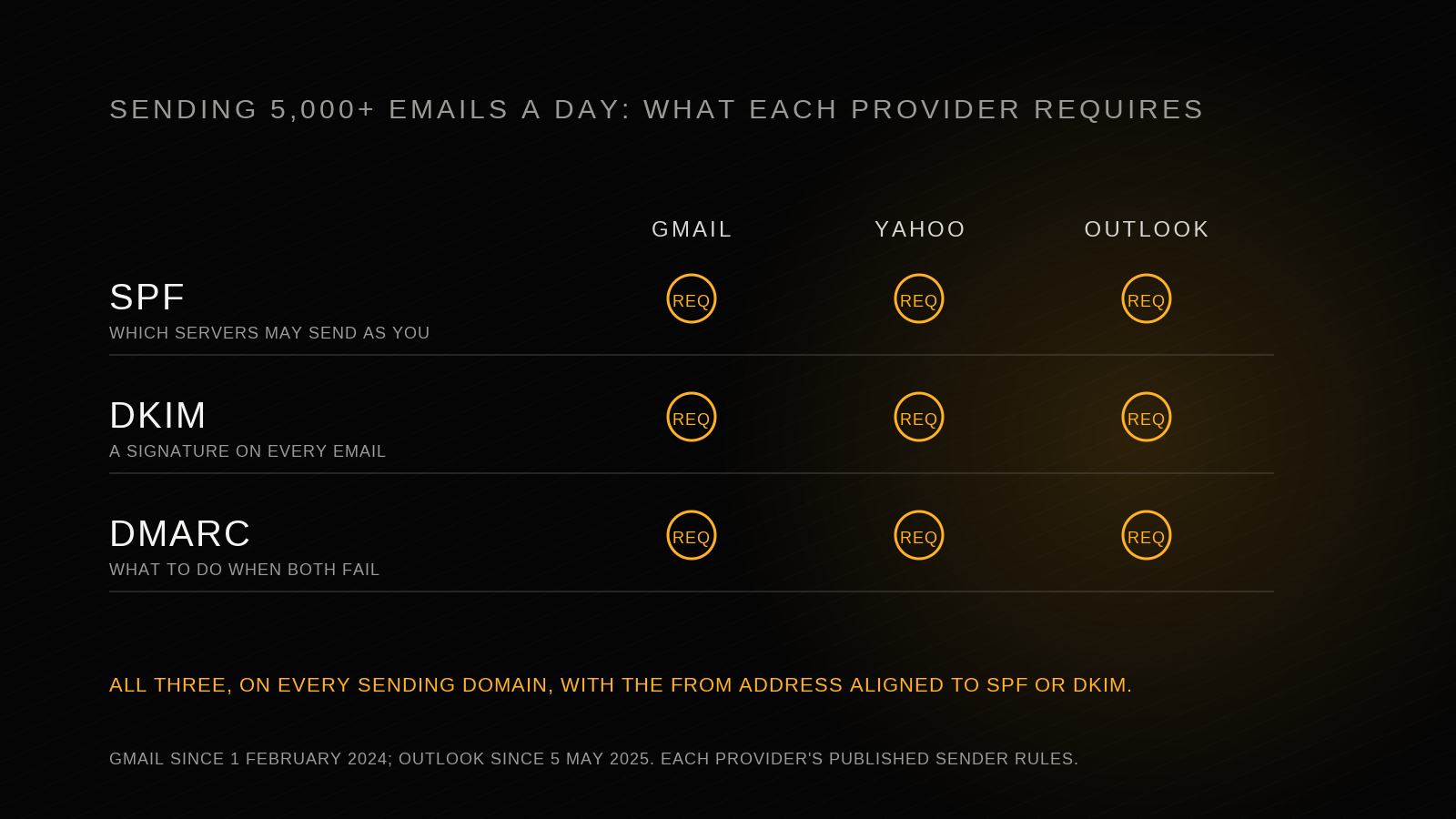
The short answer: SPF, DKIM and DMARC are three DNS records that prove an email really comes from your domain. SPF lists the servers allowed to send as you. DKIM puts a signature on every email that receivers check against a key you publish. DMARC tells receivers what to do when an email fails both for the domain in its From address, and sends you reports.
For cold email, you need all three on every domain you send from. Gmail and Yahoo require SPF or DKIM from every sender, and Gmail, Yahoo and Outlook all require SPF, DKIM and DMARC from anyone sending 5,000 or more emails a day. Check your own domain in a few seconds with our free email deliverability checker.
What do Gmail, Yahoo and Outlook require now?
The three biggest mailbox providers have each published sender rules, and they now agree on the basics. This is what each asked for when we checked their pages on 12 November 2026:
| Gmail | Yahoo | Outlook | |
|---|---|---|---|
| Every sender | SPF or DKIM | SPF or DKIM | Not covered by these rules |
| 5,000+ emails a day | SPF and DKIM and DMARC | SPF and DKIM, and DMARC of at least p=none that passes | SPF and DKIM pass, and DMARC of at least p=none |
| Alignment | From domain aligned with SPF or DKIM | From domain aligned with SPF or DKIM; relaxed alignment is fine | DMARC aligned with SPF or DKIM, both preferred |
| Spam complaints | Below 0.3%; aim for below 0.1% | Below 0.3% | Not in these rules |
| In force since | 1 February 2024 | No date on the page | 5 May 2025 (non-compliant mail goes to junk) |
Sources: Google's email sender guidelines, Yahoo's Sender Best Practices and Microsoft's announcement of Outlook's rules for high-volume senders. Gmail and Yahoo also require one-click unsubscribe for marketing and subscribed mail at bulk volume, and Yahoo asks for unsubscribes to be honoured within 2 days.
5,000 a day sounds like a lot until you count every inbox on the domain together. Treat the bulk rules as the minimum for any domain you use for cold email.
What does each record do?
Each one is a TXT record at your DNS host. None of them is complicated on its own; most problems come from having two of something, or from a record that doesn't match the domain in the From address.
| Record | Where it lives | What it says | Example |
|---|---|---|---|
| SPF | Your domain itself | Which servers may send email as this domain | `v=spf1 include:_spf.google.com ~all` |
| DKIM | `<selector>._domainkey.<domain>` | The public key receivers use to check each email's signature | Generated by your email provider |
| DMARC | `_dmarc.<domain>` | What to do with mail that fails, and where to send reports | `v=DMARC1; p=none; rua=mailto:dmarc@yourdomain.com` |
A receiving server runs the checks in order for every email it gets:
The key word is aligned. Under the DMARC standard, an email passes if SPF or DKIM passes for a domain that matches the one in the From address. Relaxed alignment is the default, so `mail.example.com` aligns with `example.com`. An email can pass SPF for your sending tool's own domain and still fail DMARC, because that domain isn't yours.
How do you set up SPF for a cold email domain?
Publish one TXT record at the sending domain that starts `v=spf1`, lists every service that sends for you, and ends in `~all` or `-all`. Three rules from the SPF standard, RFC 7208 catch most broken records:
- Only one SPF record. If a domain has more than one, SPF returns an error (permerror), which counts as a failure. Merge them into one.
- No more than 10 DNS lookups. Each `include`, `a`, `mx`, `ptr`, `exists` and `redirect` counts, including the ones inside other services' includes. Past 10, SPF returns permerror.
- End it properly. `~all` (soft fail) or `-all` (hard fail) tells receivers what to do with servers you didn't list. `+all` lets anyone on the internet send as you.
How do you set up DKIM?
Turn DKIM signing on in your email provider, then publish the key it gives you as a TXT record at `<selector>._domainkey.<yourdomain>`. The selector is a name the provider chooses, such as `google`, `selector1` or `s1`.
The most common fault isn't a missing record, it's signing that was never switched on, or a key published with an empty `p=` value, which means the key has been revoked. Either way nothing is signed. Our checker looks for keys on 25 common selector names, and lets you type in your own if your provider uses a different one.
How do you set up DMARC, and when do you tighten it?
Start with a monitoring record at `_dmarc.<yourdomain>`:
`v=DMARC1; p=none; rua=mailto:dmarc@yourdomain.com`
`p=none` asks receivers to take no action, which is the minimum Yahoo and Outlook accept. The `rua` address is where receivers send aggregate reports; without it, the standard says they mustn't send any, and you can't see who is sending as you.
Once the reports show only your own services sending, move to `p=quarantine` (treat failing mail as suspicious), then `p=reject` (refuse it). Only one DMARC record per domain: with two, receivers ignore DMARC altogether.
What changed in 2026: DMARC's original standard, RFC 7489, was replaced in May 2026 by RFC 9989. Two changes matter here. The `pct` tag, which applied a policy to a percentage of mail, has been removed; a `t=y` test flag now asks receivers to apply the policy one level lower while you check. And a subdomain without its own DMARC record now finds its policy by walking up the domain name to the organisational domain, where `sp=` sets the policy for subdomains.
Why send cold email from separate domains?
Because a domain's reputation is shared by everything sent from it. If a cold campaign draws complaints, the damage follows your invoices, your support replies and your team's everyday email.
That's why our cold email service sends from separate domains and inboxes that we buy, configure and warm up, so your main domain is never at risk. Whoever runs it, each sending domain needs its own SPF, DKIM and DMARC, and the From address should use the domain that signs the email, so DMARC aligns.
If you use a subdomain of your main domain instead, remember the inheritance rule above: without its own DMARC record, it takes its policy from the main domain's `sp=` or `p=`.
What mistakes does our free checker find?
Our email deliverability checker runs DNS lookups only, through public resolvers, so it sees what receiving mail servers see. It checks four records that decide deliverability and scores each one:
These are the faults it flags, each with a plain-words fix:
| Record | Fails when | Warns when |
|---|---|---|
| MX | No MX records, so replies can bounce | |
| SPF | No record; more than one record; ends in `+all`; needs more than 10 lookups | No `~all` or `-all` at the end |
| DKIM | Keys found, but all of them empty (revoked) | No key on the 25 common selectors (yours may use another name) |
| DMARC | No record; more than one record; no `p=` policy | `p=none` (meets the minimum, but doesn't stop spoofing) |
It also reports MTA-STS (encrypted delivery to you) and BIMI (your logo in the inbox), which are optional and don't count towards the score.
A full score doesn't guarantee the inbox: complaint rates, list quality and warm-up still decide where mail lands. Our AI lead generation guide covers the rest of the routine, and what a cold email agency should cost covers what to ask an agency that does it for you.
Common questions
Do I need SPF, DKIM and DMARC for cold email?
Yes. Gmail and Yahoo require SPF or DKIM from every sender, and Gmail, Yahoo and Outlook require all three from anyone sending 5,000 or more emails a day, with the From domain aligned to SPF or DKIM.
What DMARC policy should a cold email domain use?
Start with `p=none` and a `rua` reports address. That's the minimum Yahoo and Outlook accept. Move to `p=quarantine`, then `p=reject`, once the reports show only your own services sending.
Can I have two SPF records?
No. More than one SPF record makes SPF return an error, which counts as a failure. Merge every service into a single record.
Does DMARC need both SPF and DKIM to pass?
No. DMARC passes if either SPF or DKIM passes for a domain aligned with the From address. Setting up both gives you a second chance when one breaks.
Will cold email hurt my main domain?
Not if it's sent from separate domains. We send from separate domains set up for outreach, so your main domain's reputation stays protected.
Want the records set up for you?
Our cold email service is $2,499 a month and includes the sending domains and inboxes, bought, configured and warmed for you. If the campaign hasn't produced at least 50 positive replies in the first 60 days of live sending, we keep running it free until it does. Book a 15-minute call, or check your own domain first with the free deliverability checker.
Sources
Provider rules from Google's email sender guidelines, Yahoo's Sender Best Practices and Microsoft's Outlook high-volume sender announcement (2 April 2025), all checked 12 November 2026. Record rules from RFC 7208 (SPF) and RFC 9989 (DMARC, May 2026). Our checker's tests and scoring are from the checker's own code. Our price, terms and guarantee are from our cold email service page, checked 12 November 2026.