· Prices checked · 7 min · Code audit · Humza Sheikh
Technical Due Diligence Checklist: Run It Before They Do
The technical due diligence checklist investors and buyers work through, item by item, and why founders should run it on their own product first.
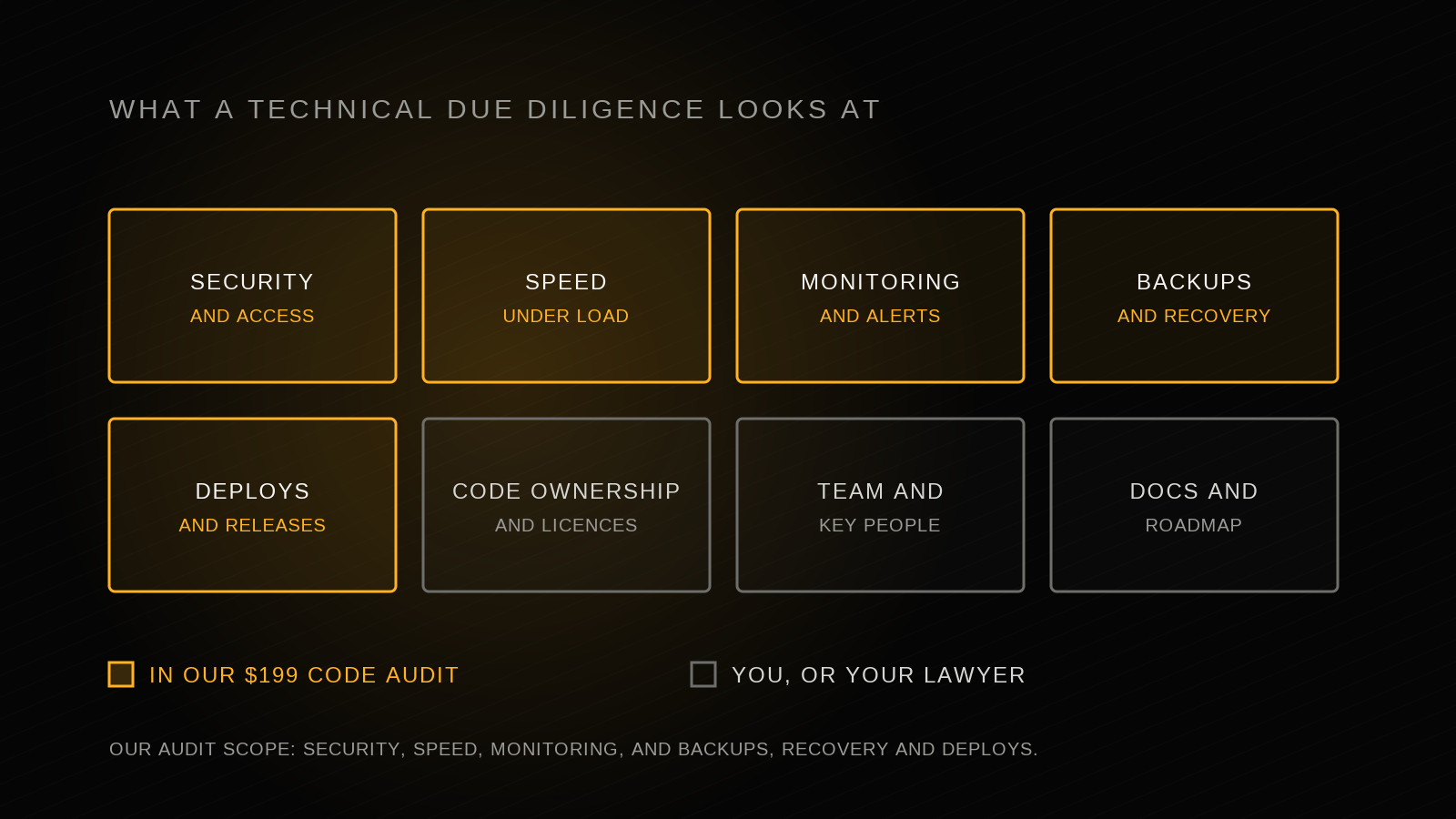
The short answer: a technical due diligence checklist covers eight areas of a software product: security and access, speed under load, monitoring, backups and recovery, deploys, code ownership and licences, the team, and the documentation and roadmap. Investors and buyers work through it before they put money in. The mistake founders make is waiting for their checklist. Run it on your own product first, and you fix what it finds on your timetable instead of theirs.
This page is the checklist, item by item, with what to have ready for each. Five of the eight areas are what our technical due diligence and code audit covers, for $199. The other three are for you and your lawyer.
What does a technical due diligence check?
Every review is shaped by the deal, but the questions fall into the same eight areas. They split into two groups: the ones a look at the code and infrastructure can answer, and the ones only the founder or a lawyer can.
| Area | What they ask | Who can answer it |
|---|---|---|
| Security and access | Who can reach what, and is customer data protected? | A code audit |
| Speed under load | What happens when users double? | A code audit |
| Monitoring and alerts | Do you hear about problems before customers do? | A code audit |
| Backups and recovery | If the database went today, what would you lose, and how fast could you restore it? | A code audit |
| Deploys and releases | Can you ship a fix safely, and roll it back? | A code audit |
| Code ownership and licences | Does the company own its code, and what do its open-source licences require? | You and your lawyer |
| Team and key people | Who understands the system, and what happens if they leave? | You |
| Docs and roadmap | Is anything written down, and what's planned next? | You |
Why run it before the investor does?
Because whatever their review finds, you answer during the deal, under their deadline. Whatever you find first, you can fix, or at least explain with a plan and a date. An investor reading "we found this, here's the fix, here's the monitoring that shows it holding" is reading a team that knows its product.
The order we'd follow:
- Run the checklist below yourself. Most of the founder-side items are things you already have; they just need gathering.
- Get the code side audited. Our audit costs $199 and gives you a ranked list of security, speed and reliability risks, each with its severity.
- Fix the critical issues. Our hardening sprint starts at $1,999, and the $199 is credited against it. Every critical issue the audit finds is fixed, or we keep working free until it is.
- Leave the monitoring on, so you can show the result rather than describe it.
- Then open the data room.
What's on the security checklist?
- Who has access to what. Every person and service with access to production, the code and the cloud account, and whether former staff and contractors have been removed.
- Secrets. No passwords or keys in the code or its history.
- Customer data. Where it's stored, who can read it, and whether it's encrypted.
- Dependencies. What third-party code the product relies on, and whether it's kept up to date.
- Logins. How users and admins sign in, and whether admin accounts have a second factor.
A common reference for web applications is the OWASP Top 10, which OWASP calls "a standard awareness document for developers and web application security". Its 2025 edition puts broken access control first, then security misconfiguration and software supply chain failures. That's why an audit looks at access and setup, not only at the code.
What do they check on speed, monitoring and uptime?
| Item | What to have ready |
|---|---|
| Speed | The slow pages or requests users feel, measured, and what's been done about them |
| Monitoring | Uptime and error alerts, and who gets woken up |
| Backups | How often, where they're kept, and when a restore was last tested |
| Recovery | How long it would take to be back up after losing a server or the database |
| Deploys | How a change reaches production, how it's tested, and how it's rolled back |
This is where a product either holds up or doesn't. The same foundations run Digyfi, a storefront with more than 1 million products, serving 150K+ monthly users at 99.9% uptime (our work). For speed, our PageSpeed case study shows the measure-first method on this site, which went from 62 to 90+.
What do they check on code ownership and licences?
Two questions, both for your lawyer to answer, not us:
- Does the company own the code? Look for signed agreements that assign the work of every founder, employee, freelancer and agency that wrote it to the company.
- What do its open-source licences require? List every open-source licence in the product. Licences differ in what they ask of you. The GNU project's GPL FAQ says a company running a modified GPL program on its website doesn't have to release its modified source, but that "the situation is different" under the GNU Affero GPL, which requires offering source to "all users interacting with it remotely through a computer network". For a web product, that difference matters, so flag any AGPL code for your lawyer.
What do they check on the team and the docs?
- Key people. Who understands each part of the system. If one person built it and holds it all in their head, say so, and show how that knowledge is being shared.
- Who builds it. In-house, contractors or an agency, and on what terms. If you're deciding how to add developers before a raise, our guide to hiring developers for a startup compares the four routes.
- Documentation. How to set the product up, how it's deployed, and the main parts of the architecture, written down.
- Roadmap. What's planned, and what in the current system would have to change for it.
Which findings must be fixed before the deal?
Not all of them. What matters is that the serious ones are fixed and the rest have a plan. We split audit findings the same way:
- Critical means anything that risks data, payments or uptime. We agree that list with you after the audit, and every issue on it is fixed in the sprint, or we keep working free until it is.
- Everything else stays on the ranked list with its severity, so you can plan it into a later sprint or hand it to your own developers.
What the audit costs, and when it isn't worth paying for, is in our code audit cost guide. In short: before you raise, sell or sign a bigger customer is exactly when it is.
Common questions
What is technical due diligence?
A review of a software product and the team behind it, done by or for an investor or buyer before a deal. It covers security, speed, reliability, deploys, code ownership and licences, the team and the documentation.
What's on a technical due diligence checklist?
Eight areas: security and access, speed under load, monitoring and alerts, backups and recovery, deploys and releases, code ownership and licences, team and key people, and docs and roadmap.
Should a founder do technical due diligence on their own product?
Yes, before the investor does. Problems you find first can be fixed or explained with a plan. Problems their review finds get answered during the deal, on their timetable.
How much does a technical due diligence audit cost?
Our code audit costs $199, for a ranked list of security, speed and reliability risks, each with its severity. Fixing the critical issues starts at $1,999, with the $199 credited against it.
Does a code audit cover open-source licences?
No. Our audit covers security, speed, monitoring, backups, recovery and deploys. Who owns the code and what its licences require are questions for your lawyer.
Getting ready for a raise or a sale?
Start with the code side. Our code audit and hardening service gives you a ranked list of risks for $199, then fixes every critical issue from $1,999, or we keep working free until it's done. Book a 15-minute call.
Sources
- Our prices, scope, terms and guarantee: the code audit and hardening page, checked 15 November 2026. The Digyfi result is from our work page.
- OWASP, OWASP Top 10:2025, fetched 15 November 2026.
- GNU Project, Frequently Asked Questions about the GNU Licenses, fetched 15 November 2026.