· Prices checked · 7 min · SEO · Humza Sheikh
How Long Does Google Take to Index a New Page? Our Log
How long Google took to index our new articles, from our own log: crawled 5 to 19 minutes after going live when we asked, and what went wrong when we did not.
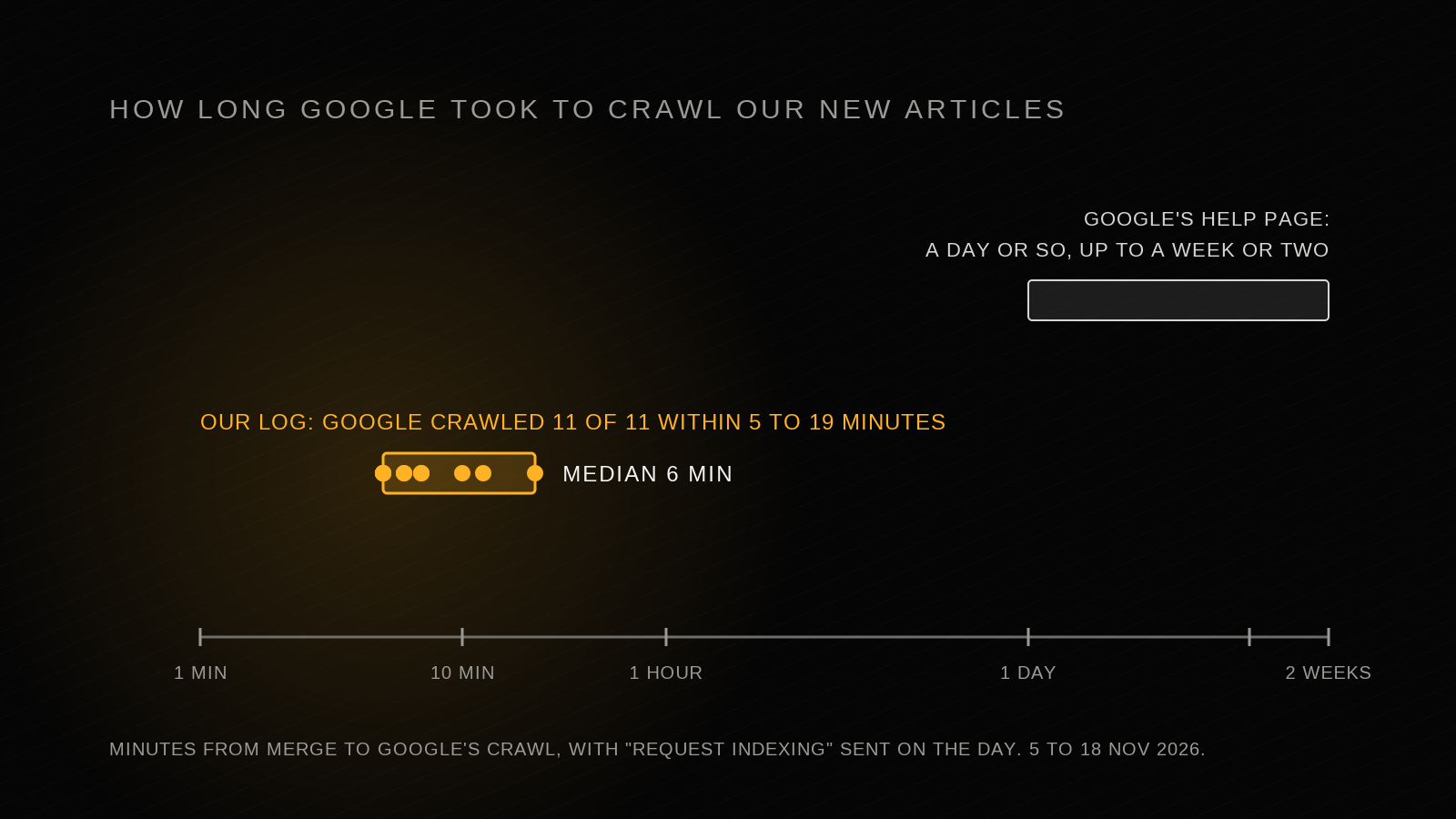
The short answer: Google's own help page says indexing "typically takes only a day or so, but can take much longer in some cases", up to "a week or two" (Search Console Help). On our site it was much faster. Between 5 and 18 November 2026, Google crawled 11 of 11 new articles within 5 to 19 minutes of each going live, when we sent Request indexing in Search Console the same morning. The median was 6 minutes.
That's one site, a small sample and a site that publishes every day, so it isn't a promise for yours. The log also shows three cases where it went wrong, and they teach more than the ones that went right. Below is what we measured, how, and the routine we now follow for every new page.
How long does Google take to index a new page?
Google gives two ranges, on two of its help pages:
| Source | What it says |
|---|---|
| URL Inspection help | "Indexing typically takes only a day or so, but can take much longer in some cases." Elsewhere: "Indexing can take up to a week or two" (Google) |
| Ask Google to recrawl | "Crawling can take anywhere from a few days to a few weeks" (Google Search Central, last updated 10 December 2025) |
| Our log, with a request on the day | Crawled within 5 to 19 minutes of going live, 11 of 11 articles; median 6 minutes |
Two words matter here. Crawling is Google fetching the page. Indexing is Google adding it to the list of pages it can show. A page has to be crawled to be indexed, but a crawl alone doesn't get it indexed, as one of our cases below shows.
Google is also clear that asking doesn't guarantee anything: "Requesting a crawl does not guarantee that inclusion in search results will happen instantly or even at all" (Google Search Central).
What did our log measure?
We publish one article a day on automization.io. Since 5 November 2026, each one has gone through the same steps, and we write down what Search Console shows at each step. For this article we put three records side by side:
- When each article went live: the time its pull request merged, which is when the site redeploys (`seo/data/2026-11-18-daily-article-merges.txt` in our repository).
- When Google last crawled it, and whether it's indexed: from Search Console's URL Inspection API, checked for every article on 18 November 2026.
- What we saw and did each day: our indexing log, one row for every URL we inspect, with what Search Console said and whether we sent a request.
One limit to be honest about: the API gives the last crawl, not the first. For the 11 articles below, the last crawl came within minutes of going live, so the first crawl can only have been in that same window. For older articles, Google has crawled them again since, so we can't say when the first crawl was and they aren't in the table.
How fast was Google when we asked?
These are the 11 articles where we sent Request indexing on the day, with the page live:
Minutes from the merge to the last crawl Search Console's URL Inspection API reported on 18 Nov 2026. The 19 minutes on 6 Nov include a first request that failed with an error and had to be sent again.
The crawl is only half of it. We re-check each URL a few days after the request, so we know the day each one was indexed by, not the exact hour. Every one of the 11 showed as on Google at its first re-check, between the same day and five days later.
The newest one gave us a closer reading. Our technical due diligence checklist merged at 03:11 UTC on 18 November 2026. A few minutes later, the URL Inspection API said "URL is unknown to Google", so we sent the request. By 03:22, the API reported it as "Submitted and indexed", with a crawl at 03:16. That's about 10 minutes from going live to indexed.
What happened when we didn't ask, or asked too early?
The log has three articles that didn't go to plan, and they're more useful than the 11 that did.
No request: a day lost. On 15 November our article on SPF, DKIM and DMARC for cold email went live, but the browser we use for Search Console wasn't connected, so no request went out. The next morning, Search Console still showed it as not indexed. We requested it then, and Google crawled it minutes later, about 24 hours after it went live.
Requested while the page wasn't there: five days lost. On 5 November we requested our MVP cost article. Google crawled it, but its last crawl that day recorded "Not found (404)". By 9 November the page had been returning normally for days, yet Search Console still had it as not on Google, because the crawl it had was of a missing page. We requested it again on 10 November, and it was on Google at our 13 November check. Since then, we only send a request once the live URL returns a normal page (a 200 status).
Requested while the site was down. On 8 November our site was briefly down when our code audit cost article went live, and Search Console's live test rejected the request with a 404. We requested it again once the site was back up, and Google crawled it that day, about 8 hours after the merge.
The lesson from all three is the same: Request indexing works quickly, but only if Google finds a working page when it comes.
Do IndexNow or a sitemap get you into Google?
Not directly. Both are worth having, but neither is a request to Google.
- IndexNow tells search engines a URL has changed. The engines that take part are listed by the protocol itself: Bing, Yandex, Seznam, Naver, Yep, the Internet Archive and Amazonbot (IndexNow). Google isn't one of them. We still send every new URL to IndexNow for those engines, but it does nothing for Google.
- A sitemap is how Google finds pages in bulk. Google's advice is: "If you have large numbers of URLs, submit a sitemap" (Google Search Central). It doesn't set a time for when they'll be crawled.
For a single new page that matters to you, the direct route is the URL Inspection tool in Search Console.
How do you get a new page indexed faster?
This is the routine our log led to. Each step is there because one of the cases above went wrong without it.
- Wait until the page returns 200. A request sent while the page is missing or the site is down can be crawled as a 404, and that's what Google keeps.
- Send it to IndexNow for Bing and the other engines that take part.
- Inspect the URL in Search Console. If it says "URL is on Google", stop: there's nothing to request.
- Request indexing once. Google is plain that repeating it doesn't help: "requesting a recrawl multiple times for the same URL won't get it crawled any faster". There's also a daily limit on requests (Google Search Central). We keep ours to five a day.
- Re-check after three days, and write down what it says. If it still isn't on Google, check that the page works, is linked from somewhere on your site, and isn't blocked, before requesting again.
Pages also need a reason for Google to keep them. Each of our articles is linked from the service pages it relates to, so none sits on its own.
When is it worth paying someone to do this?
For a handful of pages a year, you don't need to. A free Search Console account and the five steps above are enough.
It's worth paying for when indexing is part of a bigger job: a site with pages that never got indexed, a site move, or a steady flow of new pages that need checking every week. That's the technical side of our SEO service: a technical audit covering speed, indexing and site structure, a keyword plan, content and links, at $999 a month with no setup fee and no contract. If your target keywords haven't climbed in Google within 90 days, we keep working free until they do. If the new pages are part of a new site, our web design comes ready for this: built to score 90+ on PageSpeed and live by an agreed date.
Common questions
How long does it take Google to index a new page?
Google says indexing typically takes a day or so and can take up to a week or two. On our site, with Request indexing sent the same day, Google crawled 11 of 11 new articles within 5 to 19 minutes and every one was on Google at our first re-check, between the same day and five days later.
Does Request indexing in Search Console actually work?
On our log, yes: every article we requested with the page live was crawled within 19 minutes. Google doesn't promise it, though. It says a request "does not guarantee that the page will appear in the Google Index", and there's a daily limit on how many you can send.
Should I request indexing more than once?
No. Google says requesting a recrawl multiple times for the same URL won't get it crawled any faster. Request once, wait a few days, and if it still isn't indexed, find out why before asking again.
Does IndexNow work with Google?
No. Google isn't on IndexNow's list of participating search engines. IndexNow reaches Bing, Yandex, Seznam, Naver, Yep, the Internet Archive and Amazonbot.
Why was my page crawled but not indexed?
One common reason is that Google crawled it while it wasn't working. Our MVP cost article was crawled while it returned a 404 and stayed off Google for five days until we requested it again. Check the "Last crawl" result in URL Inspection, and make sure the live page returns 200 before you request.
Sources
- Google Search Console Help, URL Inspection tool, fetched 18 November 2026
- Google Search Central, Ask Google to recrawl your URLs (last updated 10 December 2025), fetched 18 November 2026
- IndexNow, participating search engines, fetched 18 November 2026
- Our own indexing log and Search Console URL Inspection data for automization.io articles, 5 to 18 November 2026